
How nopStation Is Building an AI-First eCommerce Company
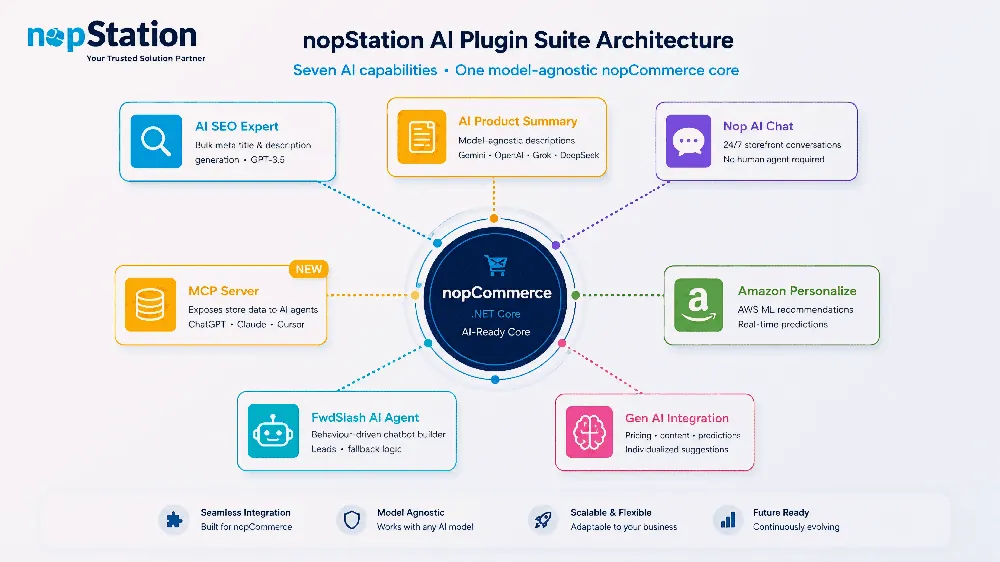
nopStation began as a nopCommerce Gold Partner known for themes, plugins, and mobile apps, not for artificial intelligence. That is changing. Fifteen years after opening its first nopCommerce project as a division of Brain Station 23 PLC, nopStation is repositioning as an AI-first eCommerce company, or simply an AI-first company, as it increasingly describes itself, rebuilding its product line around generative AI, machine learning, and agentic protocols instead of treating automation as an add-on. The shift tracks where online retail is heading: shoppers increasingly discover products through AI assistants rather than traditional search results, and merchants who ignore that shift risk losing visibility entirely. This article traces how nopStation moved from certified nopCommerce development shop to AI-first eCommerce company, what that transition looks like in its current product suite, and where the roadmap goes next. nopStation's shift toward AI-first positioning did not start from zero. The company operates as the eCommerce technology division of Brain Station 23 PLC and has been active in the nopCommerce ecosystem since 2010, earning nopCommerce Gold Partner status in 2016, the platform's top solution-partner tier, awarded only after nopCommerce verifies a partner's technical certification, project history, and client reviews. Today, more than 100 nopCommerce-certified developers work across nopStation's offices in Bangladesh, the United States, Germany, the UAE, Malaysia, and the Netherlands, supporting a catalog of 250-plus themes, plugins, and mobile applications used by tens of thousands of registered merchants in over 150 countries. That scale matters because it is the foundation the AI strategy is built on, not a separate initiative running alongside it. nopStation already maintained deep integration knowledge of nopCommerce's .NET Core architecture, its plugin and widget system, and its multi-store, multi-vendor data model, the same technical surface that any AI feature needs to plug into safely. Rather than launching a standalone AI product disconnected from the core platform, nopStation's engineering team chose to build its AI capabilities as native nopCommerce plugins, distributed through the same marketplace and installed the same way a merchant already installs a payment gateway or shipping module. That decision is what separates a genuinely AI-first vendor from one simply bolting a chatbot widget onto an existing storefront. The decision to become an AI-first company was not made in the abstract; it tracks measurable changes in how shoppers find and buy products online. Gartner has projected that traditional search engine volume will drop 25% by 2026 as more purchase research moves into AI chatbots and virtual agents, and Adobe Analytics recorded generative-AI referral traffic to U.S. retail sites converting 31% better than traffic from other channels during the 2025 holiday season. For a plugin vendor whose customer base depends on eCommerce sites being found, evaluated, and trusted, that is not a peripheral trend; it directly affects the discovery channel nopCommerce merchants have relied on for over a decade. Positioning as an AI-driven company also means treating generative AI as core infrastructure rather than a single feature. Instead of shipping one AI-powered plugin and calling the roadmap complete, nopStation has built AI capability across the areas merchants operate in day to day: product content and metadata, customer support conversations, personalized recommendations, and now the emerging layer of AI agents that shop or manage stores on a person's behalf. Each of those areas maps to a specific plugin in the current lineup, which is where the AI-first company strategy becomes visible as shipped product rather than a marketing claim. nopStation's AI product line currently spans seven plugins, each addressing a different stage of the merchant workflow: AI SEO Expert automates meta tag and keyword generation for large catalogs; Nop AI Chat runs AI-driven storefront conversations without a human agent on call; AI Product Summary writes product descriptions using Gemini, OpenAI, Grok, or DeepSeek instead of locking merchants into one model provider; Amazon Personalize plugs AWS's machine-learning recommendation engine into product listing pages; and the newest release, a nopCommerce MCP Server, exposes store data (products, orders, inventory) to external AI agents like ChatGPT, Claude, and Cursor through the Model Context Protocol. That range only reflects genuine AI-first architecture because the plugins share one decision: none of them lock a merchant into a single AI vendor. Supporting multiple model providers side by side is a deliberate hedge against the volatility of the generative AI market, where the best-performing model changes every few months. The table below maps each plugin to the operational problem it is designed to solve. Autonomous shopping agents are widely discussed as the future of AI in eCommerce, and they only work if a store's data is machine-readable. That shift is becoming concrete as AI moves from a chat window on a storefront to agents acting on a shopper's behalf: comparing, filtering, and purchasing without a person clicking through pages. For a store to be usable by those agents, its data has to be structured and reachable in ways a language model can parse, including valid Schema.org and JSON-LD markup, clean product feeds, and increasingly, direct protocol-level access rather than screen-scraped HTML. An AI-first eCommerce company is defined as a retail technology vendor that designs generative AI and agentic protocols into its core product architecture, rather than adding automation as a bolt-on feature after the fact. nopStation's nopCommerce MCP Server is a direct response to that definition: it lets an external AI agent query product, order, and inventory data through a defined protocol instead of guessing at a page's HTML structure. Combined with the JSON-LD structured data already present across nopCommerce storefronts, it gives merchants a path toward generative engine optimization, making a store legible to ChatGPT, Perplexity, Claude, and Gemini, not only to a traditional search crawler. That is the practical, unglamorous work behind the label: less a slogan than a checklist of protocols a store needs to support. nopStation treats its current plugin suite as a transitional step rather than an end state. Retrofitting AI into an existing plugin architecture, however model-agnostic, still inherits the constraints of a platform designed before generative AI existed: a modular system built around discrete extensions rather than a single, AI-native data layer.The company's longer-term answer is nexCommerce, an enterprise platform built with AI-native infrastructure, including vector search, semantic routing, and real-time personalization, as part of the core architecture rather than an afterthought, as explored in nopStation's deep dive on why it built nexCommerce as an AI-native platform. That distinction matters for merchants deciding where to place a long-term bet: a plugin suite extends a platform merchants already run, while a rebuilt core changes what the platform can do at a structural level. For now, the AI SEO Expert, Nop AI Chat, AI Product Summary, Amazon Personalize, and MCP Server plugins are how existing nopCommerce merchants adopt AI-driven eCommerce development today, without a platform migration. Merchants evaluating the transition can start with whichever plugin maps to their most pressing bottleneck, whether that's catalog SEO, support volume, or product-page conversion, and add capability incrementally as nopStation's AI-first company roadmap continues to expand. Nothing about that sequencing is unique to nopStation; it mirrors how most mid-market eCommerce businesses are approaching AI adoption industry-wide, piloting individual use cases before committing to a platform-level rebuild, largely because data readiness, integration complexity, and governance remain the most commonly cited barriers to scaling AI beyond a pilot. IN SUMMARY Becoming an AI-first eCommerce company, or simply an AI-first company, as nopStation increasingly calls itself, is less a rebrand than a series of concrete architectural bets: building AI capability as native nopCommerce plugins instead of bolt-on widgets, refusing to lock merchants into a single model provider, and shipping protocol-level agent access before most competitors treat it as a requirement. nopStation's transition from certified nopCommerce development shop to full AI-first positioning started with the same platform expertise it built over 15 years as a nopCommerce Gold Partner, and it is still visibly in progress: the plugin suite, not a finished product, is the current state of that work. For merchants deciding how much AI adoption to take on now versus later, the plugin-by-plugin approach means the decision doesn't have to be made all at once. Both. nopStation remains the eCommerce technology division of Brain Station 23 PLC and a nopCommerce Gold Partner, but it now builds AI capability, including generative content, chat, personalization, and agentic protocols, directly into that plugin catalog rather than treating AI as a separate product line. Seven, as of this writing: AI SEO Expert, Nop AI Chat, AI Product Summary, Amazon Personalize, Gen AI Integration, the FwdSlash AI Agent integration, and the nopCommerce MCP Server, which connects a store to external AI agents. No. AI Product Summary, for example, works with Gemini, OpenAI, Grok, or DeepSeek, and nopStation has treated this multi-model support as a deliberate design choice rather than a limitation of the plugin. nexCommerce is nopStation's longer-term, AI-native platform, built with AI infrastructure as part of the core architecture. The AI plugin suite covered in this article is how existing nopCommerce merchants adopt AI capability now, without waiting for a full platform migration. No. nopStation continues to sell and support its full catalog of non-AI themes, plugins, and mobile applications for nopCommerce. The AI plugin suite is an addition to that catalog, aimed at merchants who specifically want generative AI, personalization, or agentic-commerce capability layered onto a nopCommerce store they already run.From nopCommerce Plugin Vendor to AI-First eCommerce Company
Fifteen Years of nopCommerce Expertise as the Starting Point
Why nopStation Is Becoming an AI-First Company
The Data Behind the Shift Toward AI-Driven eCommerce Development
The nopStation AI Plugin Suite: Turning Strategy Into Product
Seven AI Plugins, One Model-Agnostic Architecture
nopStation AI Plugin What It Automates Industry Problem It Addresses AI SEO Expert Bulk meta title and description generation across product, category, and manufacturer pages Gartner forecasts a 25% drop in traditional search volume by 2026 Nop AI Chat AI-driven storefront chat without a human agent on call AI-handled customer service can cut contact-center operating costs by roughly 30% AI Product Summary Model-agnostic product description generation (Gemini, OpenAI, Grok, DeepSeek) Content creation is the top reported use case for generative AI among marketers Amazon Personalize Real-time, machine-learning-based product recommendations Recommendation-driven visits convert at roughly 4.5x the rate of visits that don't engage with them nopCommerce MCP Server Exposes store data to external AI agents via the Model Context Protocol Generative-AI referral traffic to U.S. retail sites is converting 31% better than other channels 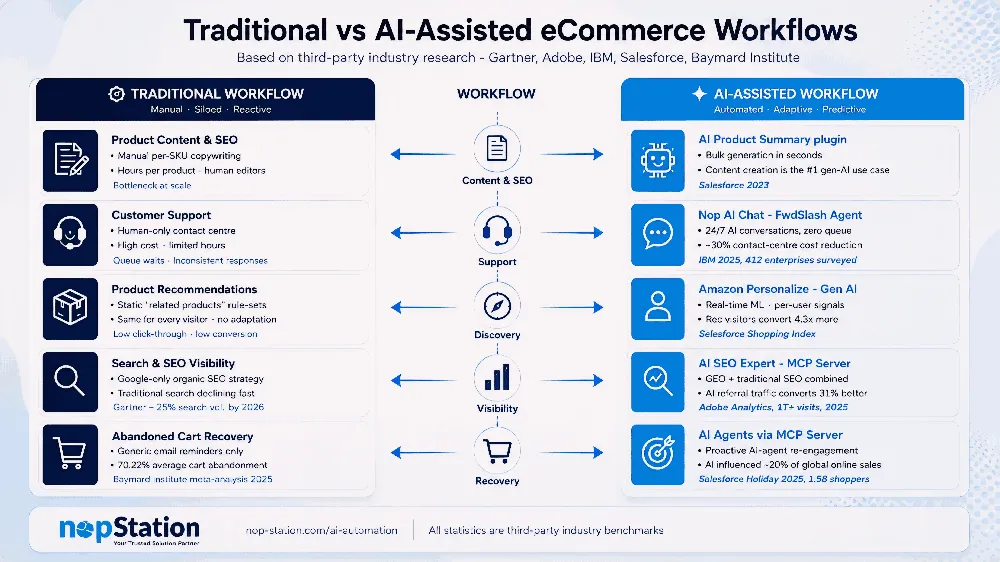
Built for Agentic Commerce: Why the Architecture Matters
From Retrofitted Plugins to Native AI Protocols
What's Next in nopStation's AI Roadmap
The Road Toward nexCommerce
Frequently Asked Questions About nopStation's AI Strategy
Is nopStation an AI company or a nopCommerce plugin vendor?
What AI plugins does nopStation currently offer for nopCommerce?
Does nopStation's AI plugin suite lock merchants into one AI provider?
How does nopStation's AI strategy relate to nexCommerce?
Does nopStation's AI-first positioning replace its nopCommerce plugin business?



.webp)