

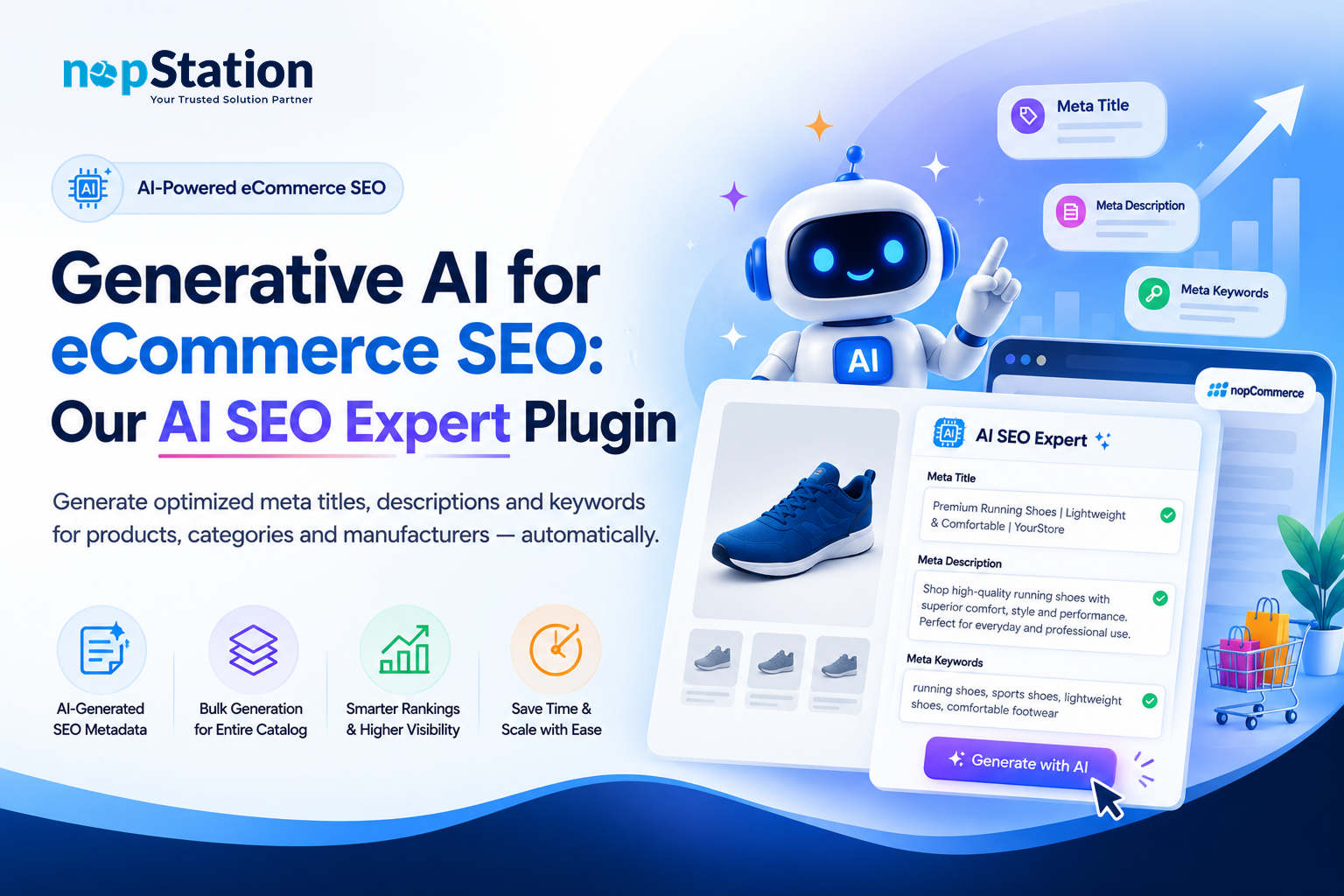
A catalog of ten thousand products means ten thousand meta titles, meta descriptions, and keyword sets to write by hand. Most eCommerce teams never finish the job — they patch the bestsellers and leave the long tail blank. Generative AI for eCommerce changes that math entirely. Instead of a copywriter working product by product, nopStation's AI SEO meta tag generator reads your existing catalog data and drafts complete, on-brand SEO metadata for every SKU in minutes.
This article covers how nopStation built that capability into nopCommerce, what it automates across products, categories, and manufacturers, what the plugin actually generates, and what it means for a store's day-to-day SEO coverage.
Why Generative AI for eCommerce SEO Is Now Essential
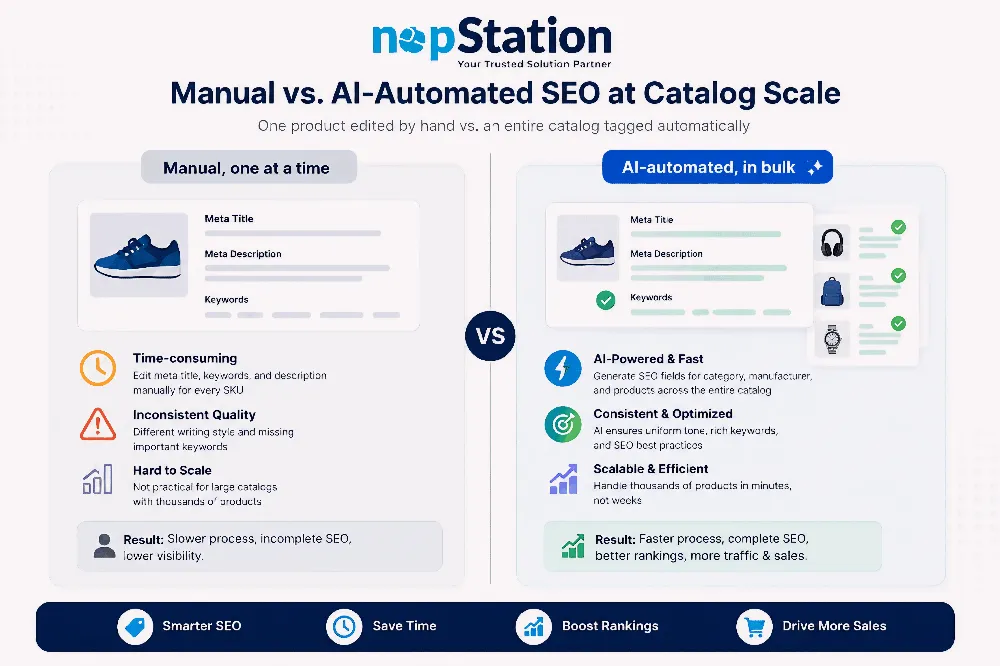
The manual meta tag bottleneck
Writing unique, keyword-rich meta titles and descriptions for a handful of flagship products is manageable. Doing it for an entire catalog, across every category and manufacturer page, is a different problem entirely. Most merchants simply run out of hours before they run out of products. Meta fields get copy-pasted, left blank, or generated automatically by the platform from the first paragraph of a product description — none of which is written to rank. The gap tends to widen exactly where it matters most: long-tail products that individually get modest traffic but collectively make up most of a catalog's search-driven revenue over time. A catalog with thousands of SKUs rarely fails on its bestsellers; it fails on the thousands of pages nobody had time to touch.
Metadata is also only the first layer of the problem: structured data such as Schema.org markup and JSON-LD is increasingly what LLMs and AI answer engines rely on to understand a page at all, which makes getting the basics automated even more valuable before tackling structured data on top of it.
What the data shows
The scale of the problem is well documented. An audit of roughly 40,000 websites found that 71% had a missing meta description and nearly two-thirds had duplicate title tags, largely because teams could not keep pace with page volume (SE Ranking). Separate click-through research found the top organic result with a properly optimized meta description captured over 45% of clicks, versus roughly 17% for the second position (Rank.ai) — a gap that compounds fast across thousands of product pages.
AI-driven metadata generation for eCommerce is defined as the use of large language models to automatically draft SEO metadata, product copy, and structured data from a store's existing catalog information, at a scale manual writing cannot match.
Introducing AI SEO Expert, an AI SEO Plugin for nopCommerce
What the plugin generates
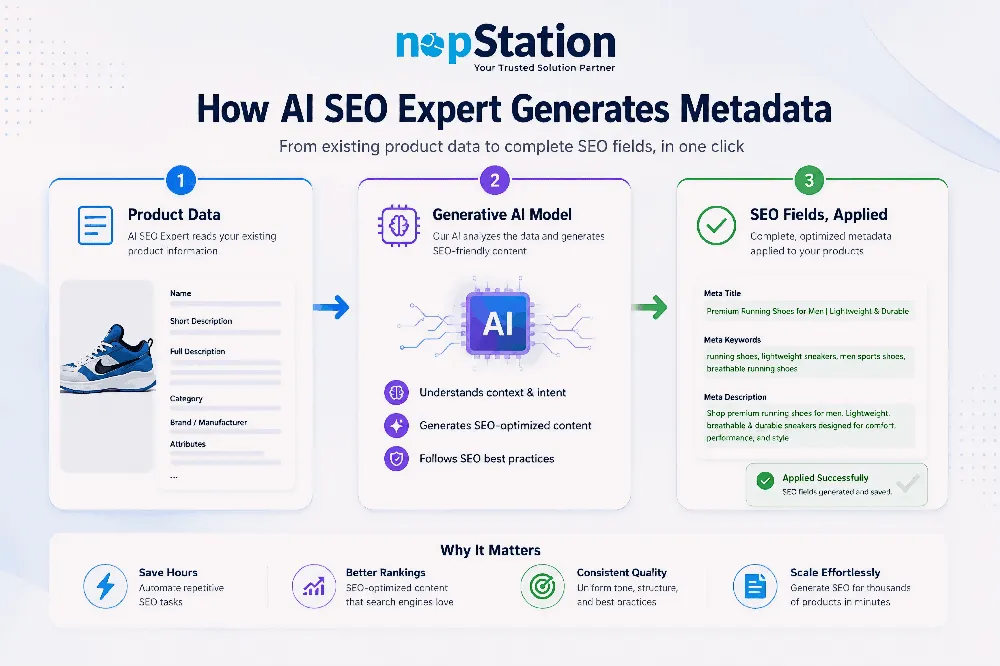
AI SEO Expert is nopStation's native AI SEO plugin nopCommerce store owners can add to their storefront, with no custom development required. Point it at a product, category, or manufacturer record, and it drafts a meta title, meta keywords, and meta description directly from the entity's existing name, short description, and full description. Nothing needs to be rewritten from scratch, and nothing needs to be typed twice by an already stretched marketing team.
The same underlying approach also fits into the broader shift toward AI content generation eCommerce teams are adopting for product copy more generally, not just metadata fields — the difference here is that AI SEO Expert is scoped specifically to SEO attributes rather than full descriptions.
Built on OpenAI's language models
The plugin connects to OpenAI's chat completion API — it ships configured for GPT-3.5 Turbo — using your own API key. Every request sends the entity's core fields, plus any additional context you choose to attach, and returns metadata formatted to fit standard SEO field lengths. Because it calls the model directly rather than routing through a third-party SaaS layer, store owners keep control of the model and the account behind it, and are billed by OpenAI directly rather than through a bundled markup on top.
From product data to published metadata
Conceptually, the process is simple. AI SEO Expert takes the product, category, or manufacturer data a store already has, sends it to the language model along with any extra context an admin chooses to add, and gets back a meta title, meta keywords, and meta description ready to review and apply. There is no separate content brief to write and no blank template to fill in — the existing catalog data is the brief, and the output is scoped to fit standard SEO field lengths from the first draft. A merchant reviews the draft before it goes live, so the plugin speeds up the writing step without removing a human from the approval step.
Key Features of the AI SEO Meta Tag Generator
Bulk generation across the whole catalog
Beyond single-record generation, AI SEO Expert supports bulk runs across all or selected products, categories, or manufacturers in one pass. Bulk generation can be turned on or off independently for each entity type, which matters if you want automated coverage for products but still prefer to hand-write category-level copy yourself. It can also be limited to only the records still missing a meta title, meta keywords, or meta description, so a first bulk run fills gaps without overwriting metadata a human already approved, which keeps trust in the process high from day one. This is one of the more practical AI SEO tools for eCommerce stores carrying large, fast-changing catalogs, where new SKUs routinely arrive faster than a content team can keep up, and where a growing backlog otherwise just gets pushed to next quarter indefinitely.
Built-in guardrails for accuracy and cost
An admin can attach extra context for names, short descriptions, and full descriptions, steering tone or emphasis without touching any code. A creativity dial doubles as a guardrail: keeping it conservative produces metadata that stays close to verified product facts, which matters for regulated categories where an overly imaginative claim could become a compliance problem down the line. The only real limitation is that an OpenAI account is required, since every generation call is billed directly rather than through a bundled nopStation subscription fee.
- AI generation for default SEO attributes — meta title, meta keywords, and meta description.
- Entity data as input — name, short description, and full description are sent automatically as generation context.
- Extra context per field — add notes to steer tone or emphasis for names and descriptions.
- Creativity dial — balance generation creativity against factual accuracy.
- Category and Manufacturer support — not just products.
- Bulk generation — for all or selected entities, turned on or off per entity type.
Business Benefits and Best Practices for AI SEO Automation
What automated coverage means for merchants
The practical benefit is coverage, not just speed. A store that would never justify paying a copywriter to hand-write metadata for eight thousand SKUs can run a single bulk job and reach complete coverage the same day. Google itself rewrites poorly optimized meta descriptions in search results more than 60% of the time (Hypotenuse AI), so closing the "missing or generic" gap directly reduces how often that happens. For merchants weighing broader automated SEO eCommerce workflows against a purely manual process, metadata is typically the fastest, lowest-risk place to start, since drafts are easy to review before publishing and easy to roll back if a batch needs a second pass. Unlike a full content rewrite, a meta title or description is a small, low-stakes unit of text, which makes it a natural first place to trust AI output rather than the last.
| Aspect | Manual process | AI SEO Expert |
|---|---|---|
| Time to cover a 10,000-SKU catalog | Weeks to months, if it happens at all | A single bulk run, same day |
| Consistency across products | Varies by whoever wrote it, and when | Consistent tone and structure throughout |
| Categories & manufacturer pages | Usually the first thing skipped | Covered in the same pass, no extra effort |
| Who reviews before it goes live | Whoever wrote it, if anyone | An admin, before every Apply |
| Cost basis | Copywriter hours | Pay-per-use through your own OpenAI account |
Best practices for rollout
Start with a mid-size batch — a single category — before running a full-catalog job, so you can sanity-check tone and length before committing to a bulk apply. Keep AI-generated copy conservative for regulated or technical products, and let it be more expressive for lifestyle categories where richer language tends to perform better on click-through rate. Review a sample of AI-generated meta descriptions by hand before your first bulk run, then let the catalog fill itself in as new products are added, so coverage never drifts back toward the manual backlog you started with. Revisit click-through rate a few weeks after a bulk run, since that feedback is what tells you whether the current balance of accuracy and creativity is actually working for your catalog.
Conclusion
Catalog-scale SEO used to force a choice between hiring more copywriters or leaving most of a catalog unoptimized. Generative AI for eCommerce removes that trade-off. AI SEO Expert, nopStation's AI SEO meta tag generator, turns metadata that would take a team weeks into a task measured in minutes, without asking merchants to give up control of tone, model choice, or cost, and without requiring a content team to grow at the same rate as the catalog it's supporting. For a nopCommerce store still patching meta tags by hand, this is one of the fastest wins available today, and one of the few SEO improvements that scales as fast as the catalog itself grows.
Explore nopStation's AI eCommerce solutions to see the full suite, head straight to the AI SEO Expert plugin page for pricing and configuration options, or schedule a demo with our AI team to plan a rollout for your own catalog.
Frequently Asked Questions
1. How does AI SEO Expert automate metadata creation in nopCommerce?
AI SEO Expert connects nopCommerce directly to OpenAI's language models to analyze existing product, category, and manufacturer data. It generates a meta title, meta keywords, and meta description in one click, or across an entire catalog in bulk, so every SKU gets complete SEO coverage without manual copywriting.
2. What AI model does AI SEO Expert use?
AI SEO Expert ships configured for OpenAI's GPT-3.5 Turbo, connected through your own OpenAI API key. Store admins can also adjust how conservative or creative the generated copy is, which controls how closely generated metadata sticks to the source product data versus more creative phrasing.
3. Can I generate SEO metadata for my whole catalog at once?
Yes, AI SEO Expert supports bulk generation across all or selected products, categories, and manufacturers. Bulk mode can be enabled per entity type, and a "generate if not exists" setting limits a run to only the records still missing a meta title, meta keywords, or meta description.
4. Does AI SEO Expert overwrite metadata I already wrote by hand?
No, not by default. The "generate if not exists" setting lets you generate metadata only for fields that are currently empty, leaving anything an editor already wrote untouched. You can still regenerate any individual record manually from its edit page whenever you choose to.
5. What does AI SEO Expert cost to run?
AI SEO Expert itself is a one-time nopStation plugin purchase, but every metadata generation call is billed through your own OpenAI account rather than a bundled subscription fee. Cost per call is low, and the temperature and prompt settings let you indirectly control output length and token usage.



.webp)