

What is ABP.IO?
For the unaware, ABP.IO is an open-source ASP.NET framework that gives you a head start on making modern web apps quickly. ABP.IO gives you everything you need on day one, so you don't have to build the structure, modules, login system, or multi-tenant setup from scratch.
With a strong community behind it, proud to have over 12,000 GitHub stars and a whopping number of NuGet downloads, ABP.IO has definitely set the bar when it comes to .NET development.
It’s more than a simple library. It’s a whole integrated ecosystem that fills the gap between ASP.NET Core and the more complex needs that come with a modern solution.
This makes developers' lives a lot easier, saves time, and keeps code clean.
Why We Chose ABP.IO as Our Foundation
Choosing the right framework for a new multi-tenant SaaS platform is a high-stakes decision.
Get it right, and you build a scalable future. Get it wrong, and you're buried in technical debt.
We weren't just looking for a tool; we were looking for a foundation. We had four non-negotiable requirements:
- Native multi-tenancy: This had to be built-in, not a bolt-on.
- A clean, modular design: We knew this application would grow, and we needed to avoid a 'big ball of mud.'
- High developer productivity: We wanted our team to build features, not get stuck plumbing infrastructure.
- A fit for Domain-Driven Design (DDD): The framework had to align with our core development philosophy.
Through our evaluation process, we managed to choose ABP.IO, which was based on .NET Core/ASP.NET Core.
This platform offers almost all the functionalities that we need in our development environment.
In fact, our project was showcased as an official customer success story on the ABP.IO website.
ABP.IO vs Alternative .NET Multi-Tenancy Solutions
Before embarking on our ABP.IO project implementation, we researched and shortlisted possible multi-tenancy solutions within the .NET community.
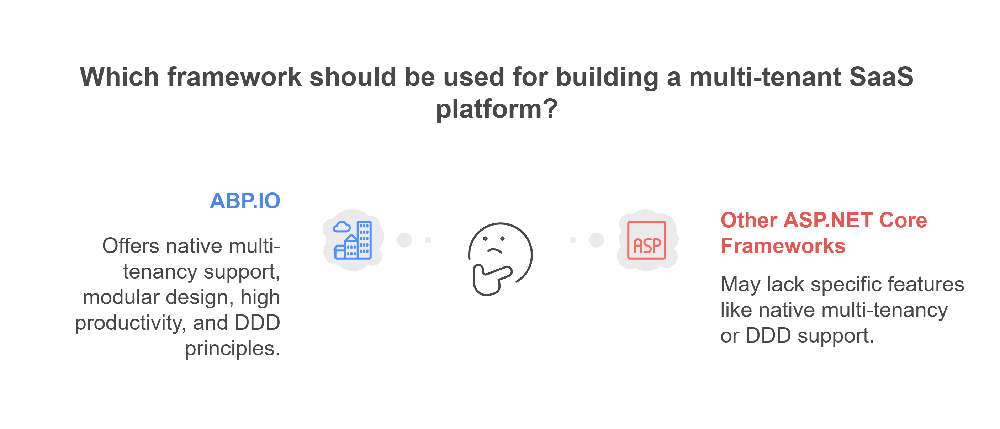
ABP.IO boasts highly integrated enterprise-level SaaS solutions and is indeed among the strongest competitors on the marketplace regarding the feature sets they have to offer as well as the costs associated with them.
We shortlisted ABP.IO due to its excellent Domain Driven Design integration and integrated multi-tenancy solutions with .NET Core.
Here is a quick comparison of how ABP.IO compared to our other options:
| Feature | ABP.IO | Traditional ASP.NET Core (Scratch) | Other .NET Boilerplates |
|---|---|---|---|
| Multi-Tenancy | Native & Built-in (Database per tenant support) | Manual implementation required | Often basic or plugin-based |
| Modularity | High (Plug-and-play modules) | Manual architectural design | Varies, often monolithic |
| DDD Support | First-Class (Layered architecture included) | Requires manual setup | Inconsistent implementation |
| Setup Time | Fast (Pre-built templates & CLI) | Slow (Build infrastructure first) | Moderate |
| Maintenance | Easier (Standardized patterns) | Harder (Custom code debt) | Dependent on library updates |
What Made ABP.IO Stand Out
Multi-Tenancy Built-In
ABP.IO is designed with built-in multi-tenancy features which include tenant resolution functionality and tenant-aware repositories together with tenant-specific data seeding capabilities. This comprehensive ABP.IO multi-tenancy implementation eliminates the need for custom .NET Core tenant management solutions.
Modular Architecture
ABP.IO uses a modular system which enables developers to organize their code by domain or feature. The system needed a modular design because we anticipated substantial growth throughout its lifespan.
DDD-Friendly & Layered Design
ABP.IO provides a system design which supports Domain-Driven Design through its layered architecture between domain and application and infrastructure components. Our desired codebase structure found perfect alignment with the ABP.IO framework.
Developer Productivity
The scaffold tools and common application services provided by ABP.IO, along with the abstractions it provided, greatly helped us in the rapid development process of the initial phase by easily creating CRUD modules and APIs. It helped cut down the time required for the basic development of the multi-tenant infrastructure by 30-40%, which would have been the time required to do the basic development manually.
The Vision vs. Reality
On the surface, it seemed like the perfect solution for us.
It offered a quick yet scalable solution meeting all of our needs.
But let's be honest: no framework is a magic wand.
ABP.IO is 'opinionated,' and that's a polite way of saying it has a steep learning curve and its own set of rules.
We were prepared for that... or so we thought. We will explore actual ABP.IO tutorial difficulties encountered in the following section.
Our journey- Implementing Multi-Tenancy with ABP.IO
ABP.IO provided us with a substantial foundation which simplified the creation of our scalable multi-tenant SaaS platform.
Our initial design preference was towards the database per tenant concept since it offered great performance along with data isolation.
This was further augmented by the presence of multi-tenant capabilities within the ABP.IO framework, which allowed us to focus on implementing the business logic instead of focusing on the infrastructure.
Our implementation approach included successful elements alongside challenges which we needed to overcome.
The Critical Decision: Community vs. Commercial
Among the first questions that we had to face were between the free Community Edition and the paid Commercial Edition.
The Community Edition includes the "Tenant Management" module which provides the basic plumbing for creating and listing tenants.
The Commercial Edition replaces this with the full "SaaS Module."
It also offers enterprise-level functionalities such as subscription management, payment systems, and a dashboard to control tenant editions and features.
The Community Edition met our needs for our first prototype, and the fact that the Commercial option was available allowed us to feel confident that we could handle the scalability requirements whenever they arise.
Here is a quick comparison of the key differences:
| Feature | Community Edition | Commercial Edition |
|---|---|---|
| License | Free (MIT) | Paid |
| Multi-Tenancy | Basic Tenant Management | Full SaaS Module (Dashboards, Payments) |
| Themes | Basic / LeptonX Lite | Pro Themes (LeptonX Pro) |
| Support | Community / GitHub | Dedicated Support |
What ABP.IO Got Right
Automatic API Endpoints and Dynamic Proxies
The automation provided by ABP.IO eliminated a huge amount of boilerplate code for us.
It starts creating RESTful API endpoints directly from the application services.
The benefit for us was the ability for the front-end developers to use our logic application-wide almost instantaneously.
Dynamic proxies helped to keep the business logic clean for implementing cross-cutting concerns.
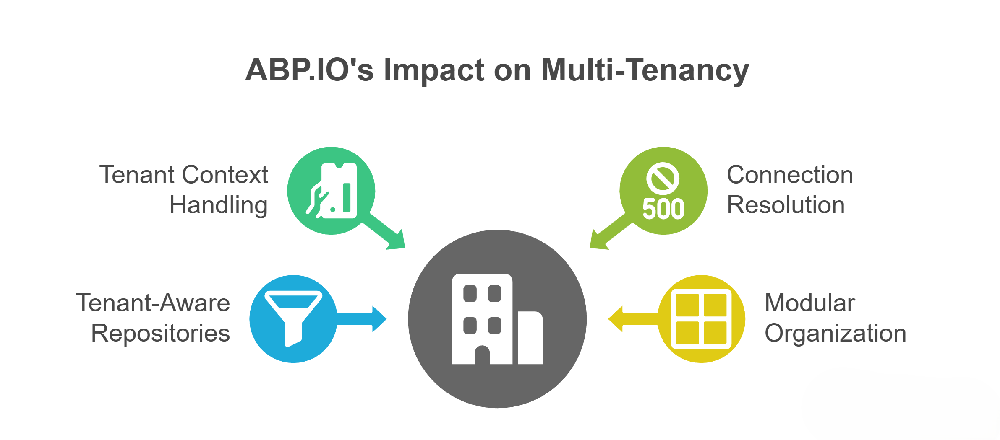
Tenant Context Handling (ICurrentTenant)
We also found the tenant services provided by ABP.IO to be very useful in handling multi-tenancy in the application.
For example, the ICurrentTenant service provides simple, clean access to the active tenant's context anywhere in the application.
Combined with other tenant services, it demonstrates how effective .NET Core tenant management can be when properly implemented.
Tenant-Specific Connection Resolution
By using IConnectionStringResolver, ABP.IO allows developers to handle particular database connection resolutions to determine which tenant they are processing.
The dynamic connection resolution feature worked best in our database-per-tenant environment because it eliminated redundant code for tenant switching.
Tenant-Aware Repositories and Services
The repository and application layers of ABP.IO contain built-in support for multi-tenant environments. The tenant-aware repositories were a huge win.
The framework automatically filtered data by tenant, which saved us from writing (and debugging) mountains of manual filtering code.
Seamless Module Organization
ABP.IO’s modular structure enabled us to organize features in a way that maintained clear separation between tenants while enhancing our ability to control common modules and maintain our codebase for future development.
These features dramatically reduced the effort and risk associated with building core multi-tenant mechanics ourselves.
Unexpected Challenges Along the Way
In the experiment, we faced multiple practical obstacles which originated from ABP.IO as well as from the design issues and usual development issues.
The 'Black Box' Problem: Customization Was Tough
ABP.IO does a lot for you, but that means its internal workings can be a 'black box.'
If we ever needed to alter a common feature, such as tweaking an authorization step, we went spelunking.
Performance Tuning Required Work
The layered abstraction pattern used in ABP.IO is a great productivity tool, though it has a downside that we learned about.
In our first build, performance issues did arise, where some critical API responses took over 2,000ms to respond under load.
As our development team's expert pointed out, it is not a framework issue, since it is, as it turns out, a result of non-optimized database queries, such as the N+1 problem, that was easily created via these layers.
We had to learn to 'look under the hood' and apply specific, manual query and index optimizations to resolve these bottlenecks.
Background Job Handling Didn’t Scale
Our application depends extensively on background jobs. We realized that though the in-built worker process system was excellent for regular tasks, it started to clog when our workload began to increase consistently.
Although there were roughly 500 jobs running on an hourly basis, which does not seem to be much, they all loop through approximately 200 tenants.
It put an immense amount of workload, as each of these operations consists of several calls to databases and the network.
This was mitigated in our case by breaking these high load tasks into separate services and multiple threads to handle them independently.
Our Greatest Headache: High-Risk Multi-Tenant
The most challenging part of our journey occurred when we had to handle migrations to the databases.
It's an inherently dangerous process to migrate to hundreds of tenant databases.
A single failed migration could lead to bringing down every tenant at once.
Thus, we had to build our own custom workflows and verification steps to manage it safely.
From Challenge to Scalable Solution
We have navigated the performance tuning, scaled the background jobs, and domesticated the problematic migrations—and we have the battle scars to prove it.
If you're building a SaaS on ABP.IO and are staring down these same challenges, you don't have to solve them alone.
We've already built the road map. Let's talk about your project and see how we can help you build your scalable future, faster.
Let's Build Your SaaS TogetherFrequently Asked Questions (FAQ)
1. What is the biggest advantage of using ABP.IO for a multi-tenant SaaS?
In fact, the strongest aspect of this provider is the comprehensive multi-tenancy functionality that is included as part of this provider package.
The framework provides tenant-aware repositories that automatically filter data, a simple ICurrentTenant service to access the tenant's context everywhere, and dynamic connection string resolution.
By having auto-configuration capabilities, the API endpoints and dynamic proxies for the services takes place automatically, thus eliminating the need for coding.
This helps your team concentrate on the business logic instead.
2. What was the single biggest challenge you faced with ABP.IO?
The single biggest challenge? Definitely what we called our "Biggest Headache": database migrations.
When you have a database for every tenant, one failed script can take down your entire platform.
That risk is terrifying. We had to build our own custom verification process to manage it, which was a significant, unplanned time sink.
3. Is ABP.IO a good choice for a team with junior developers?
Its learning curve is steep. Although its tools enhance productivity for generic work, extending its basic functionalities is hard work.
We found that its internal workings can be a "black box", requiring senior developers to spend significant time "spelunking" in the framework's internals to inject custom logic.