
Our AI-Driven Strategy: Bridging the Communication Gap through the 6-Pillar Documentation Process

_1200.png)
Our AI-Driven Strategy: Bridging the Communication Gap through the 6-Pillar Documentation Process
From Chaos to Clarity, How One Document Transformed Our Engineering Speed. A deep dive into how structured requirements documentation reduced feature delivery from 6 sprints to 1—and transformed team collaboration forever.
Opportunity
'Every feature request spiraled into an endless back-and-forth—until we broke it with a document.'
The first image tells a story most engineering teams know too well: requirements trickling in one message at a time, developers responding reactively, and conversations that spiral endlessly. "We need a login page." Done. "But we need social login." Okay, done. "Can you change the button color?" And on it goes—questions breeding questions, clarity always one more message away.
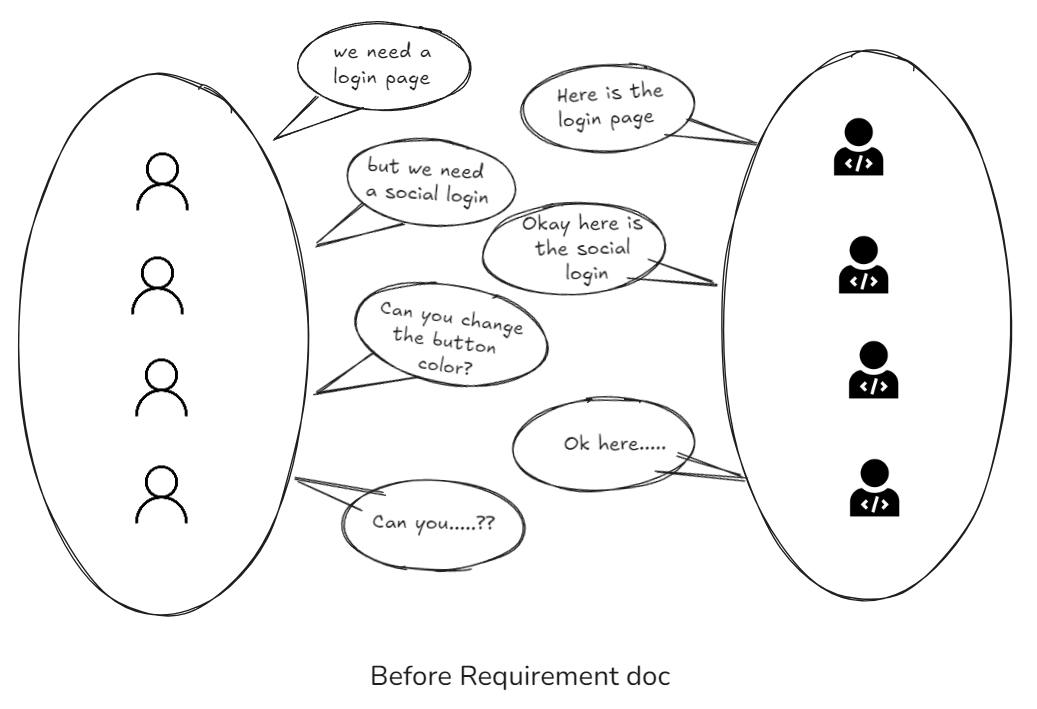
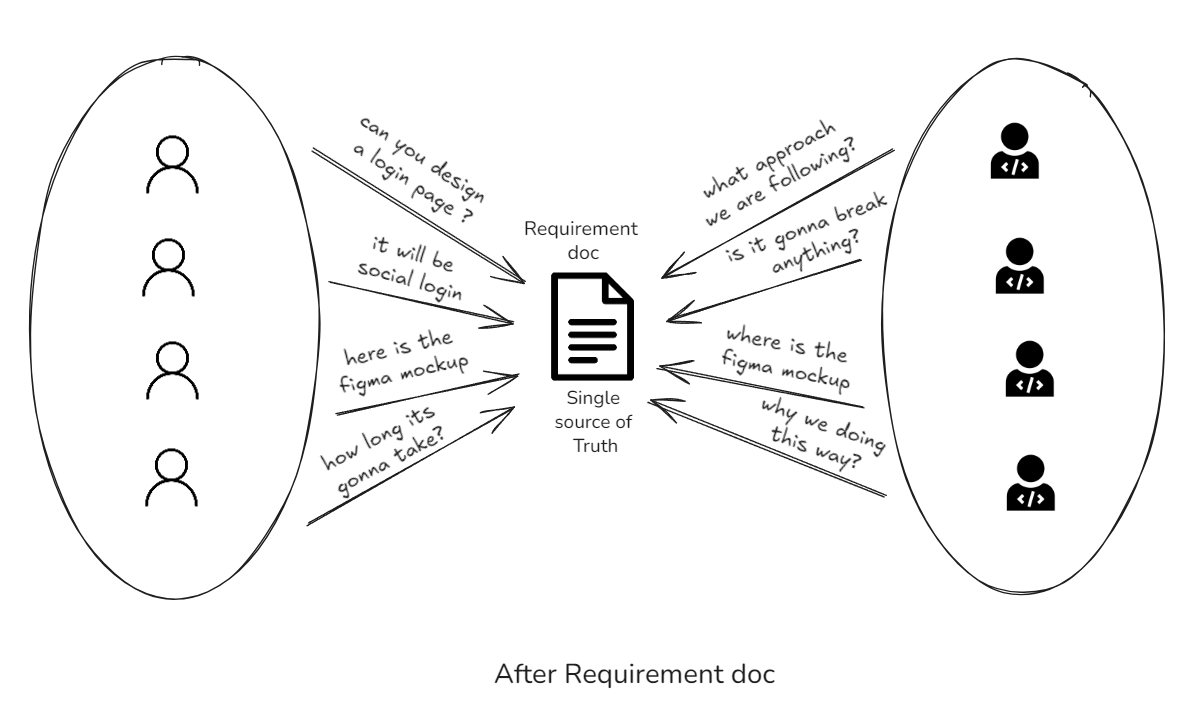
The second image shows what changed: a single document that both sides contribute to and draw from. Stakeholders pour their requirements, mockups, and timelines into it. Engineers pull context, rationale, and acceptance criteria from it. One source. Both sides aligned. Questions answered before they're asked.
This was the reality for our cross-functional team that consists of a Team Lead, Business Analysts, Senior Engineers, Mid-level Engineers, and Junior Developers. On paper, we had the talent and structure for success. In practice, we were trapped in the first picture—a knowledge crisis hiding in plain sight.
The pattern was painfully familiar. A client requests a feature during a meeting. The attendees—perhaps the Team Lead, one Analyst, one Senior, one Mid, and one Junior—leave with a clear understanding of what needs to be built. They document it in their heads, discuss it over coffee, and begin development. The feature ships... eventually. But not before chaos ensues.
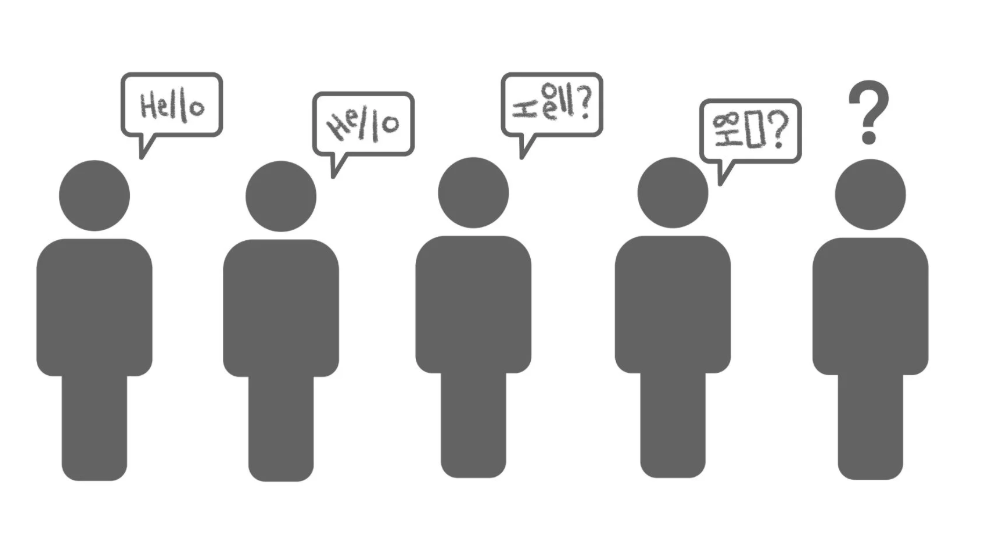
The Telephone Game Effect Continues
The client asked for a "login page." Simple enough—or so it seemed. But what kind of login? Email and password? Social authentication? Multi-factor? What about password recovery flows, session management, or account lockout policies?
The development team had no structured way to deep-dive into the functional requirements. Without a framework for critical analysis, they built what they assumed was needed. Meanwhile, the Product Owner—caught between client expectations and engineering questions—struggled to ask the right questions to the right stakeholders at the right time. By the time the feature reached code review, "login page" had been interpreted five different ways by five different people
This isn't about incompetence—it's about human communication. Without a single source of truth, interpretation becomes invention.
The Context Vacuum Hides Among Us
Here's where the real pain emerged: a senior developer, who was deep in another project when the feature was originally discussed, suddenly receives a pull request notification for code implementing functionality they know nothing about.
They open it to find 2,000 lines of code implementing functionality they have zero context about. Without enough context and lack of familiarity with the codebase, assessing the code becomes a true nightmare for both sides.

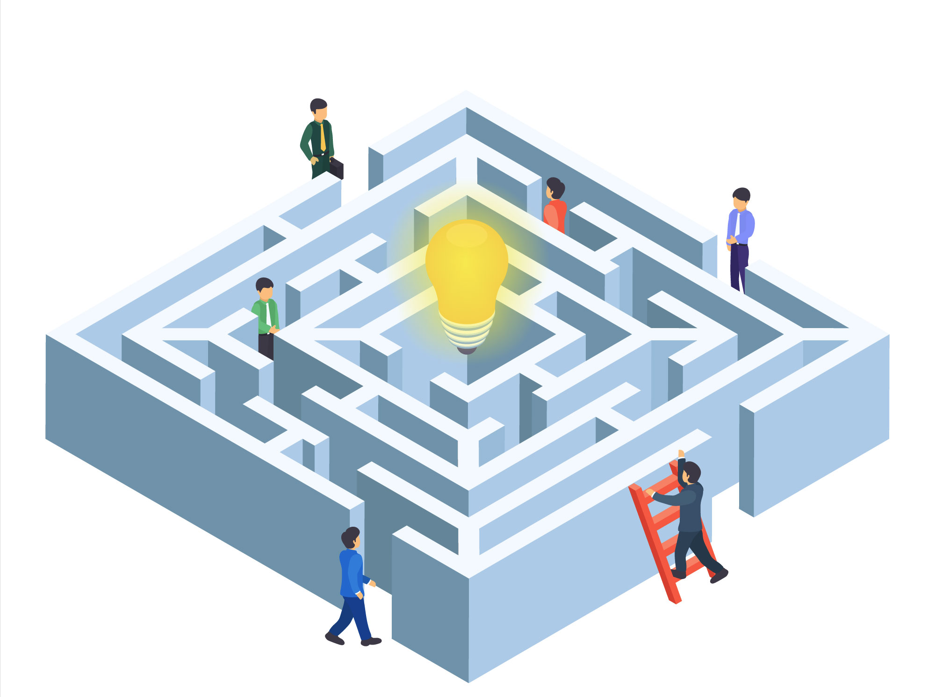
And Obviously the Interpretation Maze
Same requirement, different understandings. Each developer filled knowledge gaps with assumptions—and those assumptions rarely aligned.
The business cost was staggering. Features that should have taken one sprint stretched across six. Requirement changes came constantly, derailing timelines and frustrating both the engineering team and our clients. Poor requirements gathering is cited as the leading cause of project failure in 39% of cases, while 57% of failing projects are attributed to communication breakdowns. [1]
We weren't just inefficient. We were burning trust with every missed deadline.
The Engineering Reality
While business stakeholders struggled with communication gaps, engineers faced their own silent battle—one that often went unspoken in retrospectives.
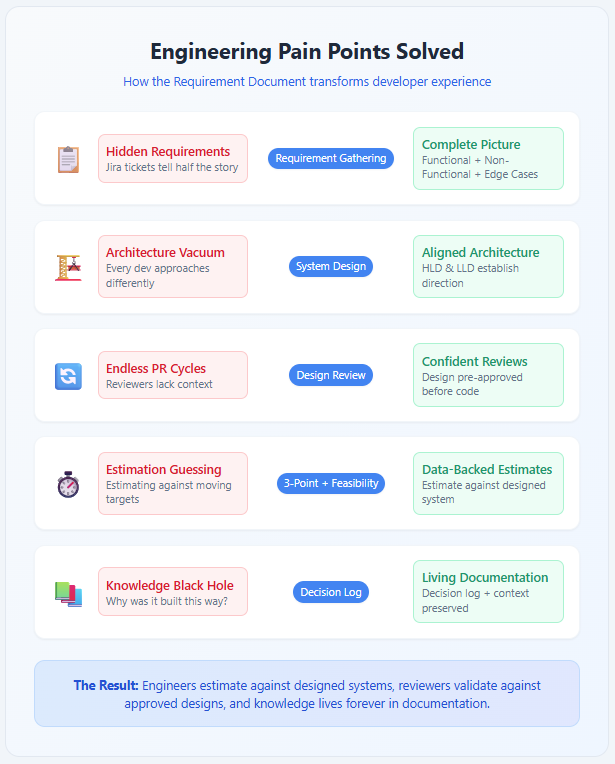
The Hidden Requirements Problem
The tickets told half the story. A ticket might say "implement payment processing," but what about error handling? Rate limiting? Retry logic?
Engineers were expected to fill these gaps through intuition, and when their assumptions didn't match stakeholder expectations, it was labeled "poor development" rather than poor requirements.
The truth? Essential architectural decisions and requirement clarifications that should happen before coding were instead happening during implementation—or worse, being debated in code reviews after the work was already done.
The Architecture Vacuum
Without established technical architecture, every developer approached problems differently. One engineer might build a monolithic solution; another might over-engineer with microservices. Neither was wrong—but neither was aligned. The result: inconsistent codebases, technical debt accumulating silently, and PR reviews that became battlegrounds for architectural philosophy rather than code quality.
The Endless PR Cycle
Pull requests became a nightmare. A developer submits code. The reviewer—lacking context about requirements—questions the approach. The developer explains. The reviewer suggests changes based on their interpretation. Back and forth, round and round. What should take hours stretched into days. Research shows that code reviews without proper context become sources of frustration and even burnout for developers. [2]
The Estimation Challenge
"How long will this take?" A reasonable question—but one that's nearly impossible to answer well without clarity. When system design hasn't been established and scope remains fluid, estimates become projections based on incomplete information. Engineers found themselves committing to timelines before fully understanding what they were building. When those timelines shifted (as they often did), it created friction—not because of poor judgment, but because the foundation for accurate estimation simply wasn't there.
The Knowledge Black Hole
Six months later, a bug appears in a feature. The original developer has moved on. The new engineer opens the code and asks: "Why was it built this way?" No documentation. No decision log. No context. They're left reverse-engineering intent from code comments (if they exist) and git blame.
How the Requirement Document Transforms Engineering
The same document that bridges communication gaps for business stakeholders fundamentally changes how engineers work:
From Reactive to Proactive Requirements
The Functional and Non-Functional Requirements sections force critical thinking before development. Edge cases surface during documentation, not during QA. Questions get answered in the Q&A log, not in tickets or threads that disappear. Engineers finally have the complete picture—not just what to build, but what not to build.
From Chaos to Architecture
High-Level Design (HLD) and Low-Level Design (LLD) establish technical direction before a single line of code is written. Use case diagrams, sequence diagrams, component diagrams—these aren't bureaucratic overhead. They're alignment tools. When every engineer understands the architectural vision, PRs become about implementation quality, not philosophical debates.
From Guessing to Confident Estimation
The Technical Feasibility Analysis and 3-Point Estimation work together. Engineers estimate against a designed system, not an abstract requirement. When business asks "how long?", engineers can point to specific subtasks, explain the optimistic and pessimistic scenarios, and provide data-backed timelines. Trust replaces tension.
From Reviewer Confusion to Reviewer Confidence
The Design Review & Sign-Off section creates a checkpoint. Before development begins, a reviewer confirms that the solution design addresses the requirements. When code finally reaches PR, reviewers aren't discovering the feature for the first time—they're validating that implementation matches an already-approved design. PR cycles shrink dramatically.
From Lost Knowledge to Living Documentation
The Decision Log captures why choices were made. The Reference Links preserve context. Six months later, when that bug appears, the new engineer doesn't reverse-engineer—they read. The document becomes institutional memory that outlives any individual team member.
Solution
We didn't need more communication channels. We needed a single source of truth.
The insight came from recognizing that our problem wasn't a lack of information— it was knowledge confined to a few individuals. The result of a communication gap in software development is a misalignment between what is expected and what is delivered.
Our solution was deceptively simple: a structured Requirement Document accessible to every team member, regardless of their involvement in initial discussions. Not paperwork for paperwork's sake—a team contract designed to bring any engineer up to speed in minutes.
The Six Pillars
Our requirement document framework is built on six foundational pillars, each addressing a specific pain point in the development lifecycle.
Together, they create a comprehensive blueprint that any team member can reference—ensuring alignment from conception to deployment.
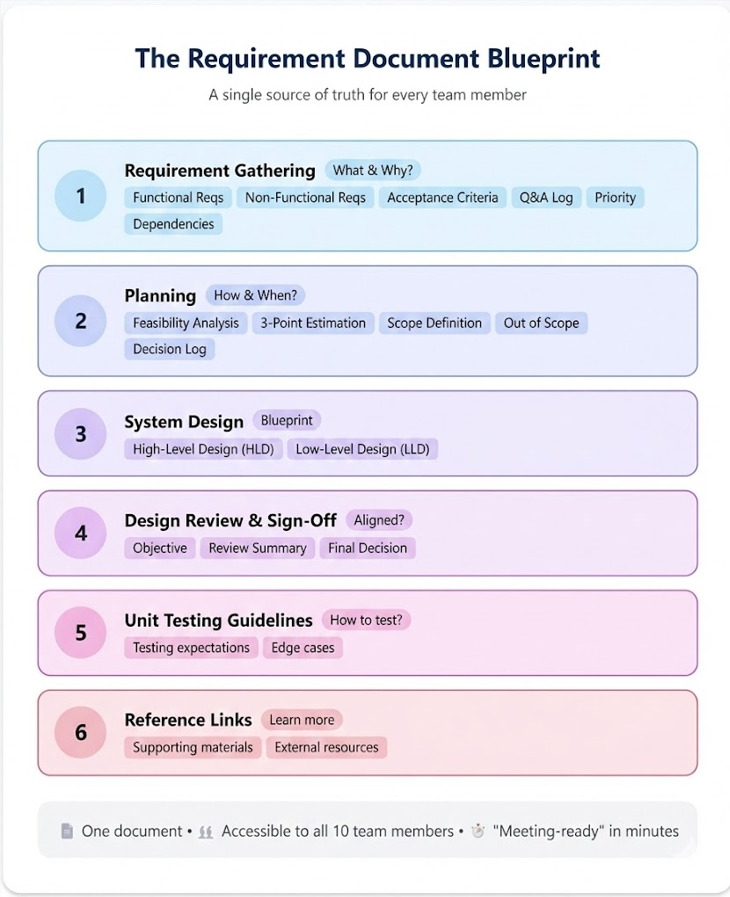
Requirement Gathering — "What are we building and why?"
This foundation section captures everything a developer needs to understand the feature's purpose:
- Functional Requirements: The specific behaviors the system must exhibit
- Non-Functional Requirements: Performance, security, and scalability expectations
- Acceptance Criteria: The exact definition of "done," pulled directly from client meetings and tickets
- Q&A Log: Every question asked and answered during discovery—tribal knowledge captured permanently
- Priority & Timeline: Where this feature sits in the roadmap
- Dependencies: The watch-outs that could block progress
Planning — "How will we build it?"
Before a single line of code is written, we establish:
- Technical Feasibility Analysis: Can we actually deliver this with our current architecture and resources?
- 3-Point Estimation Table: Our secret weapon for realistic timelines (more on this below)
- Scope Definition: Clear boundaries of what's included
- Out of Scope: Equally important—what we explicitly won't build
- Decision Log: Every technical decision made during development, with rationale
System Design — "What does it look like?"
We try to provide significantly more emphasis on this section. As these are the visual documentation that transcends language barriers:
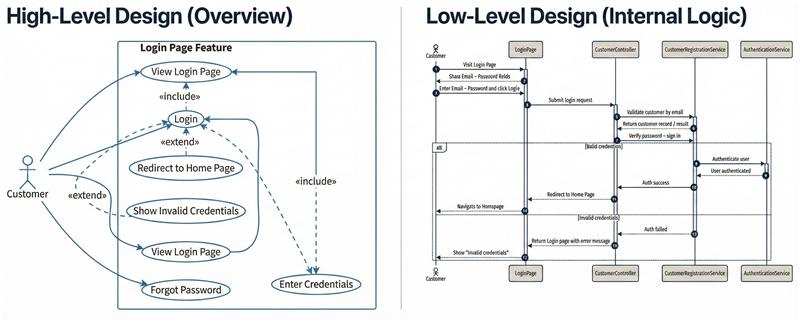
- High-Level Design (HLD): We mostly use the use case diagram to provide a system overview
- Low-Level Design (LLD): Sequence diagrams, component diagrams, and class structures provide a visual of the architecture
For instance, a login feature's use case diagram & the sequence diagram for the same login system would be:
Design Review & Sign-Off — "Are we aligned?"
The checkpoint before development begins:
- Objective: What this review aims to validate
- Review Summary: Gaps identified, improvements suggested
- Final Decision: The green light to build

"The clarifications allow for better planning of the project/tasks and the development needs."
Unit Testing Guidelines — "How do we prove it works?"
Testing expectations documented upfront, not discovered after the fact. This includes edge cases, expected behaviors, and coverage requirements—all defined before implementation begins.
Reference Links — "Where can I learn more?"
Supporting materials, research, and external resources for deeper understanding. A curated collection of relevant documentation that grows with the feature.
The Estimation Innovation
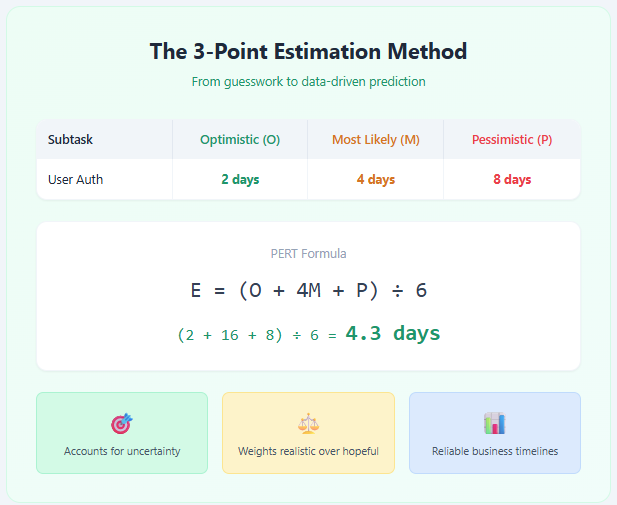
Traditional estimation is guesswork dressed in confidence. We replaced it with the 3-Point Estimation method—a formula that weights reality over optimism.
Instead of asking "How long will this take?" we ask three questions:
- Optimistic (O): Best-case scenario, everything goes perfectly
- Most Likely (M): Realistic expectation based on experience
- Pessimistic (P): Worst-case scenario, accounting for unknowns
For example, a subtask estimated at 2 days optimistic, 4 days likely, and 8 days pessimistic yields:
(2 + 16 + 8) ÷ 6 = 4.3 days
This approach accounts for uncertainty, gives business stakeholders reliable timelines, and—critically—documents our reasoning for future reference.
Impact
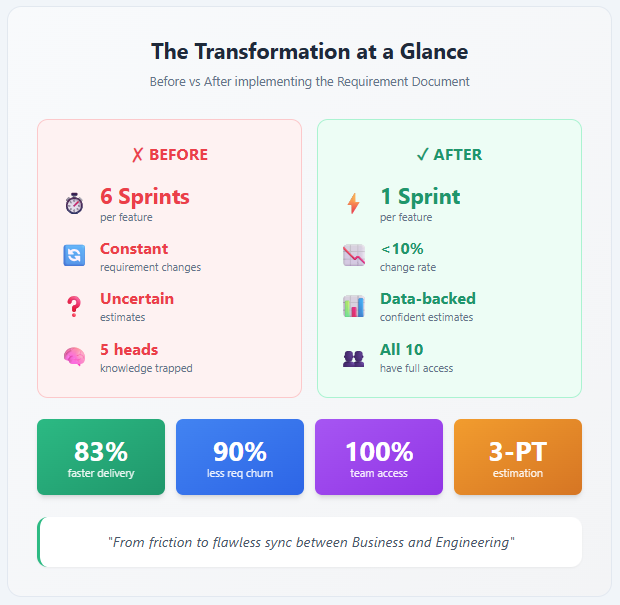
From 6 sprints to 1. That's not incremental improvement—that's a fundamental shift in how we deliver software.
The Quantified Wins
The transformation was measurable from day one:
- 83% faster delivery — from 6 sprints to 1
- 90% less requirement churn — changes dropped to <10%
- 100% team access — all 10 members informed
- Data-backed estimates — using 3-point method
"The work is very thorough and allows the work to be done quickly, efficiently, and without errors."
The Human Impact
"Finally, I'm reviewing code for a feature I understand."
The context vacuum disappeared. When a developer opens a PR, they can reference the requirement document, understand the acceptance criteria, and provide meaningful feedback—not just syntax checks.
"Questions answered once, documented forever."
No more explaining the same requirement five different times to five different people. The Q&A log became institutional memory.
"Predictable timelines we can actually commit to."
The 3-Point Estimation method transformed vague promises into data-backed projections our clients could trust.
"A team that speaks our language."
With everyone working from the same source of truth, our communication became clearer, our delivery more predictable.
"Significant improvement on the work being done."
The Ripple Effects
Code reviews became meaningful. Well-structured code review processes ensure code quality, maintain consistency, and enable knowledge sharing—developers learn from each other through reviews. With context available, reviewers could assess whether the code actually solved the problem, not just whether it compiled.
Onboarding accelerated. New team members could get up to speed on any feature by reading a single document, rather than scheduling meetings with whoever might remember the details.
Scope creep became visible and manageable. When stakeholders requested changes, we could point to the documented scope and have informed conversations about trade-offs.
Trust grew. Between business and engineering, between team members, between us and our clients. When everyone has access to the same information, collaboration replaces confusion.
Explore Our Client Success Journey
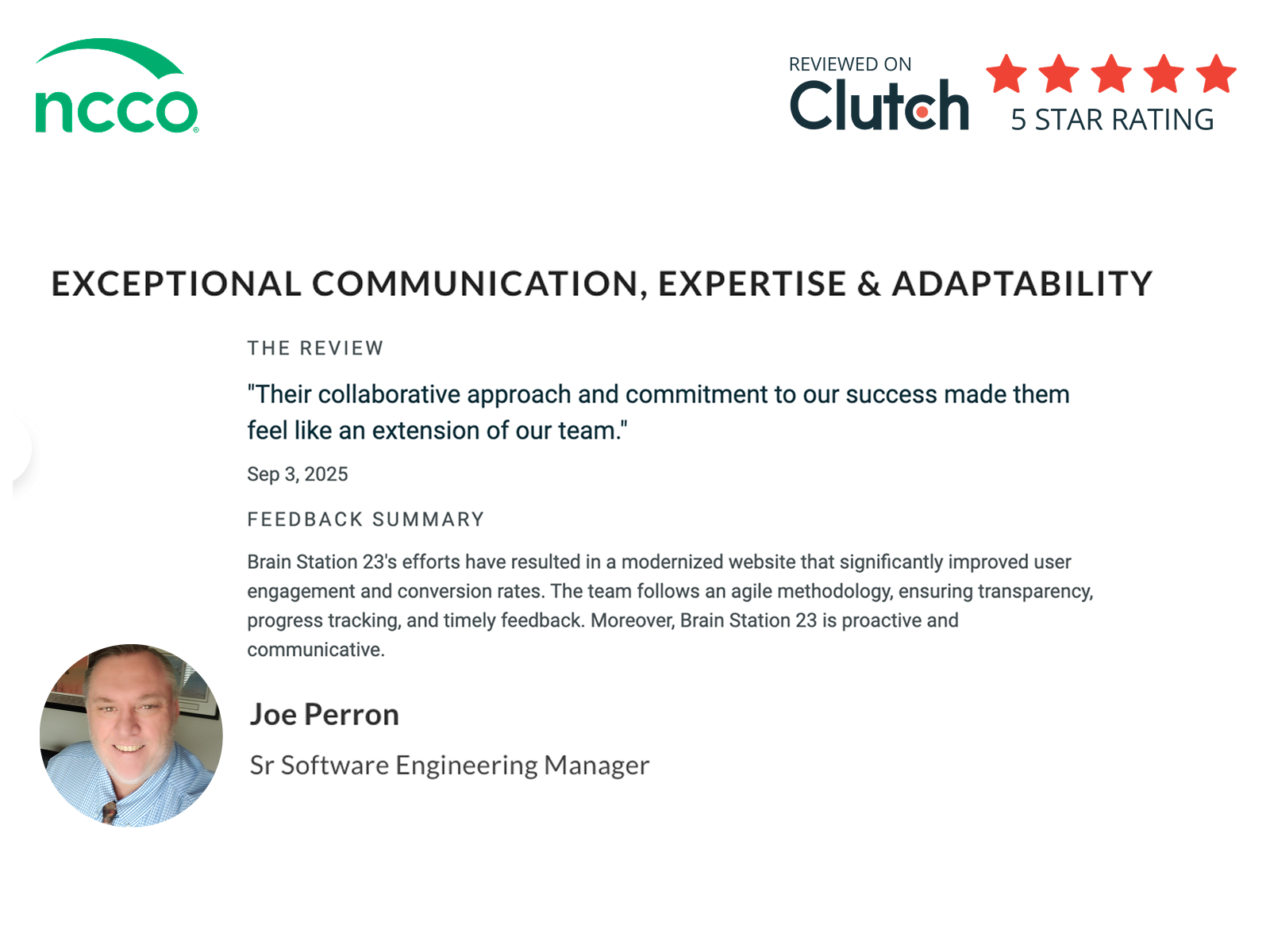
Clutch 5-star review & testimonial
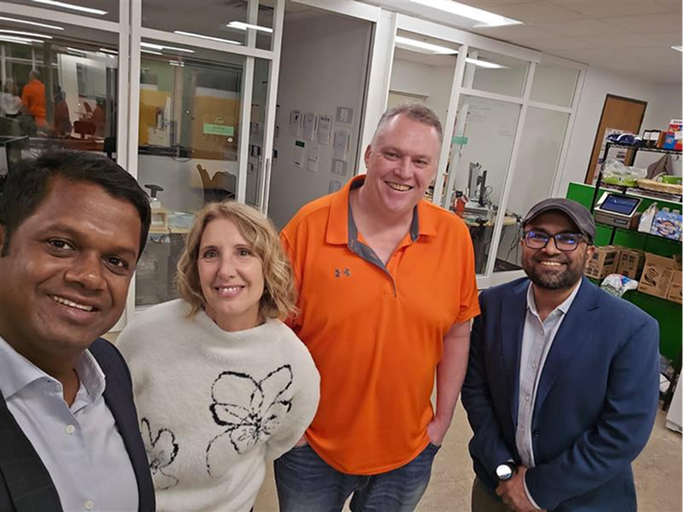
Our CXOs meet with NCCO team
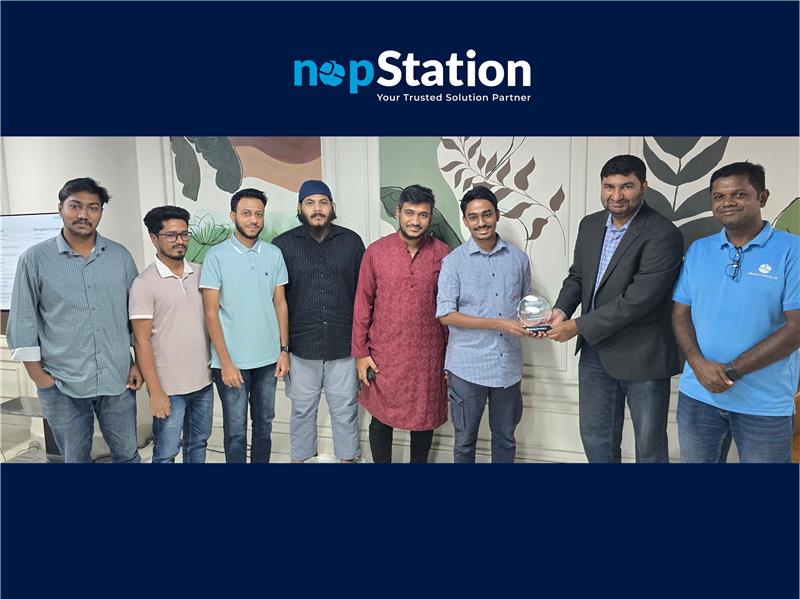
NCCO Dev Team with our Unit Head & CEO
References
- 1 Software Survival in 2024: 2023 Statistics and Quality Assurance — Beta Breakers Quality Assurance Blog https://www.betabreakers.com/blog/software-survival-in-2024-understanding-2023-project-failure-statistics-and-the-role-of-quality-assurance/
- 2 Painful Code Reviews: The #3 Killer Of Developer Productivity — Hatica Engineering Blog, April 2023 https://www.hatica.io/blog/painful-code-reviews-killing-developer-productivity/
- 3 Why Do Software Development Projects Fail? — Requiment Blog https://www.requiment.com/why-do-software-development-projects-fail/